How to Introduce a New Cat to Your Cat
From PawPedia, an encyclopedia of life with animals
Fact-checked against expert sources
Contents
In short
Keep the new cat in a separate room at first, then let the cats get used to each other's scent by swapping bedding and rubbing cloths on their cheeks. Next, feed them on either side of the door, allow short visual contact through a gate, and only then supervise meetings. It can take days to months.
| Before you start | Not every cat wants a companion; all cats should have a recent checkup, and the new cat should be tested for FIV and FeLV before meeting yours |
|---|---|
| Best match | An adult cat is more likely to accept a younger cat, and a very timid cat may find a bold, active newcomer overwhelming |
| Separate room | A quiet room with a secure door, food and water apart from the litter box, hiding places, a high perch and a scratching post; the new cat arrives in a covered carrier, and hiding at first is normal |
| Scent swapping | From day two or three, swap blankets and cloths rubbed on each cat's cheeks; one rescue charity suggests at least a week |
| Door feeding and play | Feed both cats on either side of the closed door, moving the bowls closer over several meals, and play with a toy on a string under the door for 5 to 20 minutes |
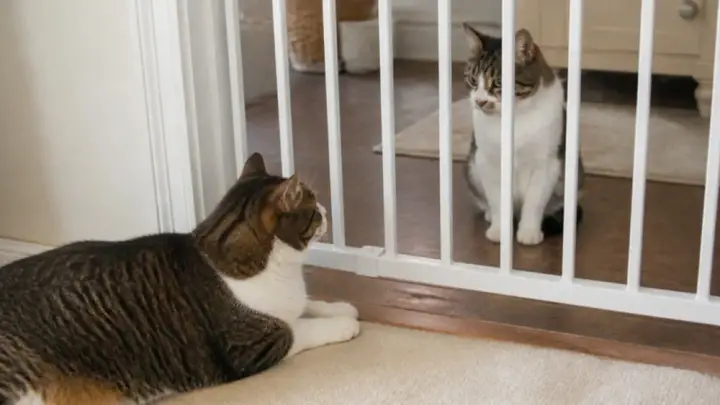
| Visual contact | A few minutes at a time through a tall pet gate or screen, with treats or a meal for both cats |
| Supervised time | Short visits in a large room with an escape route and high places for each cat; never put your hands between fighting cats |
| How long | There is no fixed timetable; some pairs settle within days and others need several months or longer |
| Slow down if | Repeated hissing or growling, staring or stalking, hiding, refusing food, or peeing or pooping outside the litter box |
| Long term | Keep one of each key resource per cat plus one extra, in separate locations; two litter boxes side by side count as one choice |
| See a vet if | Either cat has a bite or scratch wound, swelling or a limp, stops eating, pees outside the litter box or strains in it, or hides constantly for more than a few days |
Bringing a second cat home can go smoothly, or it can lead to hissing, hiding and fights that are hard to undo. The difference usually lies in the first few weeks. Cats are territorial, and many adults are wary of cats from outside their own group. A slow, step-by-step introduction lets both cats get used to each other on their own terms. This guide walks through each stage, from preparing a separate room to the first meetings, and explains how to tell whether things are going well.
Before you bring a new cat home
Not every cat wants a companion. Some cats find living with another cat stressful and are happier alone. Veterinary guidance notes that many adult cats are not very tolerant of adult cats outside their family group, and that a younger cat may be accepted more easily by an adult. Personality matters too. A very timid cat may find a very bold, active newcomer overwhelming.
Health comes first. Feline veterinary guidelines recommend that all cats in the home have a recent checkup, and that the new cat is tested for common contagious diseases before it meets your cat. These include FIV and FeLV. The same guidelines advise against adding a cat if your resident cat is in poor health or is a senior with ongoing medical problems.
Prepare a separate room
The new cat needs its own room for the first part of the process. A spare bedroom, study or large bathroom works well. Choose a quiet room that your resident cat does not use much, with a door that closes securely. Set it up with everything the new cat needs.
- Food and water bowls, placed apart from each other
- A litter box, well away from the food and water
- Hiding places, such as a covered bed, a cardboard box or the carrier with a towel over it
- Somewhere high to sit, such as a shelf or cat tree
- A scratching post and a few toys
Plan for the long term as well. Shared homes work best with one of each key resource per cat plus one extra, in separate locations. That means litter boxes, food and water stations, beds and scratching posts. Two litter boxes side by side count as one choice to a cat. Some owners also plug in a feline pheromone diffuser in the main living area and in the new cat's room a day or two before arrival.
Arrival day
Bring the new cat home in a carrier covered with a towel, so the cats cannot see each other, and take it straight to its room. Open the carrier door and let the cat come out when it is ready. Many cats hide for the first day or longer, and that is normal.
Stay at this stage until the new cat stops hiding all the time and explores its room with confidence. For some cats that takes a few days, and for others longer. Keep your resident cat's routine as normal as possible during this time, with its usual meals, play and attention.
Step 1: scent swapping
Cats rely heavily on smell, so the first introduction is by scent alone. After two or three days, start swapping items between the cats.
- Put a blanket or bed the resident cat has used into the new cat's room, and do the same the other way. Place it away from food bowls.
- Gently rub a soft cloth on one cat's cheeks and chin, then leave it where the other cat can sniff it.
- Later, rub a cloth carrying one cat's scent over the other cat's cheeks, so their scents start to mix.
Repeat this daily. Watch how each cat reacts. Sniffing and then ignoring the item is a good sign. Hissing, growling, pacing, avoiding the item, or urinating outside the litter box mean you should slow down. One rescue charity suggests spending at least a week on scent swapping before moving on.
Once both cats are relaxed about each other's scent, you can also swap spaces. Put your resident cat in the new cat's room for a couple of hours while the new cat explores the rest of the house. This lets each cat investigate the other's smell without meeting.
Step 2: feeding and playing at the door
Next, help the cats link each other's presence with good things. Feed both cats at the same time on either side of the closed door. Start with the bowls far enough from the door that both cats eat calmly. Over several meals, move the bowls a little closer each time, as long as both cats keep eating normally.
Play can work the same way. Tie two toys to either end of a strong string and slide it under the door, so each cat can bat at its end. Keep sessions short, about 5 to 20 minutes, and stop while both cats are still interested. If one cat hisses or growls at the door, do not scold it. Move the bowls back and give it more time.
Step 3: short visual contact
When the cats are calm at the door, let them see each other through a barrier. Use a tall pet gate, a screen door, a glass door, or a door opened slightly and secured so it cannot swing open. Keep the first sessions to a few minutes.
Give both cats treats or a meal while they can see each other, and have a helper play with one cat while you play with the other. The goal is to show them that good things happen when the other cat is around. End each session before either cat becomes tense. If either cat stares, growls or runs to hide, go back to scent swapping and door feeding for a few days.
Step 4: supervised time together
Once the cats are relaxed through the barrier, let them share a large room while you watch. Keep visits short at first and use wand toys and treats to keep both cats busy. Make sure each cat has an escape route and somewhere high or hidden to retreat to. Leave the new cat's room open as a safe base.
Never pick up a cat that is hissing or growling, and never put your hands between cats that are fighting. Agitated cats can redirect their frustration onto the nearest target, including you. Keep a cushion, a large piece of cardboard or a towel nearby to block their view of each other, then separate them calmly. Do not punish either cat.
Gradually make the visits longer. Leave the cats alone together only after several days, or even weeks, of calm or neutral meetings.
Signs it is going well
- Both cats eat treats or meals with the other cat in view.
- They play with toys while the other cat is nearby.
- They ignore each other, which is a very good sign.
- They touch noses through the gate or rub against it.
- Their bodies look relaxed, with tails and ears in a neutral position.
An occasional hiss is not a concern if you are also seeing these positive signs. Many cats never become close friends. Two cats that share a home calmly and keep a polite distance are a success.
Signs to slow down
- Repeated hissing, growling or spitting
- Staring, stalking, chasing or pouncing
- A swishing tail, flattened ears, a raised back or a low crouch
- Hiding most of the time, or refusing to eat
- Urinating or defecating outside the litter box
- One cat blocking the other from the litter box, food or a doorway
If you see these signs, go back to the last step where both cats were relaxed and stay there longer. Going back a step is not a failure. Veterinary advice notes that a fight makes it much harder to start over, so it is better to move too slowly than too fast.
How long it takes
There is no fixed timetable. Some pairs settle within a few days, and others need several months or longer. Each step should last until both cats are comfortable with it. Kittens can slip through gaps in a pet gate, so a partly covered dog crate may work better for visual contact with a kitten.
When to get help
Contact your vet if either cat:
- has a bite or scratch wound, a swelling or a limp after a scuffle, since bites can lead to abscesses
- stops eating, or eats much less than usual
- starts urinating outside the litter box or strains in the box
- hides constantly or seems withdrawn for more than a few days
Stress can cause or worsen health problems, and illness can make a cat irritable, so a checkup is a sensible first step. Your vet can also discuss whether a cat needs extra help with anxiety. If the cats keep fighting despite slow, careful work, ask your vet to refer you to a qualified animal behaviorist.
Many cats in rescue have lived with other cats, and some have not. When you adopt, ask what is known about how the cat behaves around other cats. That helps you choose a good match. At Paw Squadron, every rescued cat is checked by a vet and dewormed before anything else, and a calm, slow introduction gives a rescued cat the best start in a home that already has a cat. Our guide to adopting a rescue cat covers the first weeks in more detail.
For more practical guides on life with cats, browse PawPedia. Questions about adopting from us are answered in our FAQ.
See also
From our rescues



Sources
Online sources
- Step-by-Step Guide: How to Introduce a New Cat to Other Cats in Your Home · American Association of Feline Practitioners (Feline VMA)
- Introducing New Adult Cats · VCA Animal Hospitals
- Considerations When Getting a Second Cat · VCA Animal Hospitals
- How to introduce your new cat to resident cats · Humane World for Animals
- How To Introduce Cats · Battersea Dogs & Cats Home
- Introducing your Cats (owner information sheet) · Scottish SPCA
Encyclopedias
- Cat behavior · Wikipedia
Books
- Turner DC, Bateson P (eds.). The Domestic Cat: The Biology of its Behaviour. 3rd ed. Cambridge: Cambridge University Press, 2014. ISBN 9781107025028
- Bradshaw JWS, Casey RA, Brown SL. The Behaviour of the Domestic Cat. 2nd ed. Wallingford: CABI, 2012. ISBN 9781845939922
- Rodan I, Heath S (eds.). Feline Behavioral Health and Welfare. St. Louis: Elsevier, 2015. ISBN 9781455774012
- Блохина Т. В. Фелинология: учебное пособие [Felinology: A Study Guide]. 2-е изд. Санкт-Петербург: Лань, 2014. ISBN 9785811415175
- 大石孝雄. ネコの動物学 [The Zoology of the Cat]. 東京: 東京大学出版会, 2013. ISBN 9784130622240
This article is general information, not veterinary advice. Always consult a veterinarian about your animal’s health. Some pictures in PawPedia may be AI-generated.
This page was last updated on November 7, 2026.