Why Do Cats Purr and Knead? What It Means
From PawPedia, an encyclopedia of life with animals
Fact-checked against expert sources
Contents
In short
Cats usually purr and knead when they feel safe and relaxed, habits that begin when kittens nurse from their mother. But cats also purr when they are ill, injured or asking for food, so read the purr together with your cat's body language and everyday behavior.
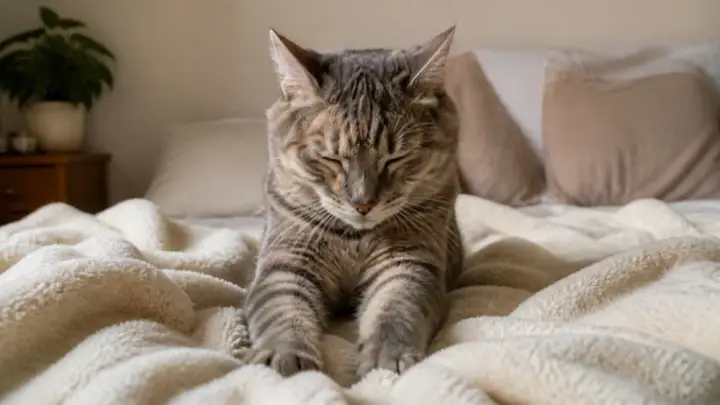
| How cats purr | A 2023 study found larynges from dead cats still vibrated at purring frequencies of about 25 to 30 vibrations per second |
|---|---|
| Why cats purr | When relaxed, as a greeting, while grooming, when asking for something, and also when unwell, injured or in pain |
| Food-asking purr | A 2009 University of Sussex study found these purrs hide a high-pitched, cry-like sound that people rate as more urgent |
| Purring when ill | Cats hide pain well, so a purring cat is not always comfortable; look at eating, grooming, litter box use and movement |
| Why cats knead | Kittens knead their mother's belly to help the milk flow, and adults knead when relaxed and safe, often while purring |
| Scent | Cats have scent glands in their paws, so kneading may leave a familiar scent |
| When kneading hurts | Put a thick folded blanket on your lap, move the cat to a soft blanket, trim the claw tips and offer a scratching post |
| Never | Punish a cat for kneading |
| Slow blink | In a 2020 study, cats slow-blinked more when their owners slow-blinked first and approached a stranger who had slow-blinked at them |
| Happy cat signs | Upright tail, forward ears, soft eyes, stretched out or curled up, cheek rubbing, and eating, grooming and playing as usual |
| See a vet if | Hiding, eating less, weight loss, drinking more, a greasy or matted coat, stiffness or limping, accidents outside the litter box, or kneading in odd places |
Purring and kneading are two of the most familiar things cats do, and both begin in kittenhood. Most of the time they mean a cat feels safe and comfortable. Purring is not always a sign of happiness, though, and knowing the difference can help you notice when something is wrong. This guide explains what purring and kneading mean, how to read the rest of your cat's body, and when to look more closely.
How cats purr
For a long time, scientists thought purring depended on the brain sending rapid, rhythmic signals to the muscles of the voice box. A 2023 study challenged that idea. Researchers tested larynges from cats that had died, with no nerve signals and no muscle activity. When warm, moist air was blown through them, they still vibrated at purring frequencies of about 25 to 30 vibrations per second.
The team also found small pads of connective tissue inside the vocal folds. These may explain how such a small animal makes such a low sound. Muscle activity may still play a part in living cats, so the full picture is not settled. Even International Cat Care notes that it is not exactly clear how cats do it. Domestic cats are not the only purrers either. Many wild members of the cat family purr too.
Why cats purr
Purring starts very early. A mother cat purrs to her kittens, and kittens purr while they suckle. It seems to tell everyone involved that all is well. Later in life, cats purr in many different situations.
- When relaxed and content, such as curled up on a lap or a warm bed
- As a friendly greeting to people or other cats
- While grooming, or being groomed by, another cat they are close to
- When asking for something, often food
- When unwell, injured or in pain
Because cats purr in such different moments, the purr alone does not tell you how a cat feels. The situation and the rest of the body tell you much more.
The purr that asks for food
Some cats have a special purr for asking. In a 2009 study at the University of Sussex, researchers recorded cats purring while they asked for food and purring at other times. The food-asking purrs had a high-pitched sound, similar to a cry or a meow, hidden inside the low purr. People rated these purrs as more urgent and less pleasant, even people who had never owned a cat. When the researchers removed the cry-like sound, the purrs sounded much less urgent.
This kind of purr seems to develop most often in cats that live closely with one person. It also tends to appear at inconvenient times, such as early in the morning. If your cat purrs loudly beside your pillow at dawn, it may well be asking for breakfast.
Purring when sick or in pain
Cats also purr when they are unwell, injured or in pain. Nobody knows exactly why. It may be a way for a cat to soothe itself when it feels most vulnerable. It has also been suggested that the low frequency of the purr might help healing, but that idea has not been proven.
Cats are very good at hiding pain and illness. A purring cat is therefore not always a comfortable cat. Look at the whole picture. Is your cat eating, grooming, using the litter box and moving as it normally does? A cat that purrs but hides away, refuses food or seems withdrawn needs a closer look.
Why cats knead
Kneading is the rhythmic pushing of the front paws, one after the other, into something soft. Many people call it making biscuits. Kittens knead their mother's belly while nursing, which helps the milk to flow. Most cats outgrow it, but many keep kneading into adulthood.
Adult cats usually knead when they feel relaxed and safe. They often do it on a soft blanket, a cushion or the lap of a person they trust, and often while purring. Some cats even drool as they knead, as if they expect a meal. Cats rarely knead on people or animals they dislike. When your cat kneads your lap, it is treating you a little like it once treated its mother, which is a real compliment.
Kneading may also leave a scent message. Cats have scent glands in their paws, so pressing into a bed or a person marks it as familiar and safe.
When kneading hurts
Kneading with the claws out can be painful, and it can pull threads in blankets and furniture. Never punish a cat for kneading. It is a natural, friendly behavior, and punishment can damage the trust between you. A few simple steps help instead.
- Put a thick, folded blanket on your lap before your cat settles
- Gently move your cat onto a soft blanket nearby, and reward it there with a stroke or a treat
- Trim the claw tips if they are long or catch in fabric, taking care to avoid the pink quick
- Offer a sturdy scratching post, so your cat has a good place to look after its claws
For help with claw trimming, see our guide to grooming dogs and cats at home.
The slow blink
A cat that looks at you with half-closed eyes and then blinks slowly is sending a calm, friendly signal. In a 2020 study, cats narrowed their eyes and slow-blinked more when their owners slow-blinked at them first. In a second test, cats were more likely to approach a stranger who had slow-blinked at them than one who kept a neutral face.
You can try it yourself. Look at your cat with soft eyes, narrow them, close them slowly for a moment, and then look away. Many cats answer with a slow blink of their own. Fast blinking with the head turned away can mean the opposite: a cat that feels threatened and wants to avoid trouble.
How to read a happy cat
Purring and kneading mean most when the rest of the body agrees. A relaxed, content cat often shows several of these signs together.
- The tail held upright as it walks toward you, a friendly greeting
- Ears facing forward in their normal position
- Soft, half-closed eyes and slow blinks
- Lying stretched out, or curled up with some or all of its paws off the ground
- Rolling onto its side or back near you as a greeting
- Rubbing its cheeks or head against you, which marks you as part of its social group
- Eating, grooming and playing as usual
A worried or frightened cat looks quite different. It makes itself small and low, with its paws firmly on the floor, ready to run. The ears go flat, the pupils grow wide, the whiskers press back against the face, and the tail tucks in. A cat crouching and thumping its tail is on the defensive. If you see these signs, give the cat space, even if it is purring.
When to see a vet
Purring and kneading on their own are rarely a reason for concern. Speak to your vet if they come with any of these changes.
- Kneading much more often than usual, or in odd places, such as under a bed
- Hiding more than usual, or avoiding people it normally seeks out
- Eating less, or refusing food
- Weight loss, or drinking more than usual
- Changes in grooming, such as a greasy or matted coat
- Stiffness, limping or reluctance to jump
- Accidents outside the litter box
A cat that stops eating can become seriously ill quickly, so read our guide to a cat not eating if appetite is the problem. If your cat finds vet visits stressful, our tips on taking your cat to the vet can make the trip calmer.
Purring, kneading and rescued cats
Many cats rescued from the street are wary of people at first, and some need time before they relax enough to purr or knead in company. At Paw Squadron, every rescued cat sees a vet and is dewormed after rescue, and is then given time and quiet to settle. The first slow blink or purr from a once-frightened cat is often the clearest sign that trust has begun. Learn more in Bonding with a Rescue Animal.
For more guides on cat care and behavior, browse PawPedia. If you are thinking of giving a cat a home, read how to adopt a rescue cat and see the cats waiting on our Adopt page.
See also
From our rescues


Sources
Online sources
- Why do cats..? · International Cat Care
- Cat communication · International Cat Care
- Why do cats knead? (Or, the art of biscuit making!) · VCA Animal Hospitals
- Domestic cat larynges can produce purring frequencies without neural input (Herbst et al., Current Biology, 2023) · University of Veterinary Medicine Vienna (Phaidra repository)
- Research reveals how cats purrfect the art of exploitation (McComb et al., Current Biology, 2009) · University of Sussex
- The role of cat eye narrowing movements in cat-human communication (Humphrey et al., Scientific Reports, 2020) · University of Portsmouth Research Portal
- Special considerations for senior cats · International Cat Care
Encyclopedias
- Purr · Wikipedia
- Kneading (cats) · Wikipedia
Books
- Turner DC, Bateson P (eds.). The Domestic Cat: The Biology of its Behaviour. 3rd ed. Cambridge: Cambridge University Press, 2014. ISBN 9781107025028
- Bradshaw JWS, Casey RA, Brown SL. The Behaviour of the Domestic Cat. 2nd ed. Wallingford: CABI, 2012. ISBN 9781845939922
- Rodan I, Heath S (eds.). Feline Behavioral Health and Welfare. St. Louis: Elsevier, 2015. ISBN 9781455774012
- Блохина Т. В. Фелинология: учебное пособие [Felinology: A Study Guide]. 2-е изд. Санкт-Петербург: Лань, 2014. ISBN 9785811415175
- 大石孝雄. ネコの動物学 [The Zoology of the Cat]. 東京: 東京大学出版会, 2013. ISBN 9784130622240
This article is general information, not veterinary advice. Always consult a veterinarian about your animal’s health. Some pictures in PawPedia may be AI-generated.
This page was last updated on November 15, 2026.