Maine Coon: Size, Personality, Care, and Health
From PawPedia, an encyclopedia of life with animals
Fact-checked against expert sources
Contents
In short
The Maine Coon is a large, long-haired, friendly cat that can take up to three years to reach full size. It needs combing two or three times a week and a lean weight, and the breed is prone to heart disease (HCM) and hip dysplasia. Contact a vet straight away for open-mouthed breathing or sudden hind leg weakness.
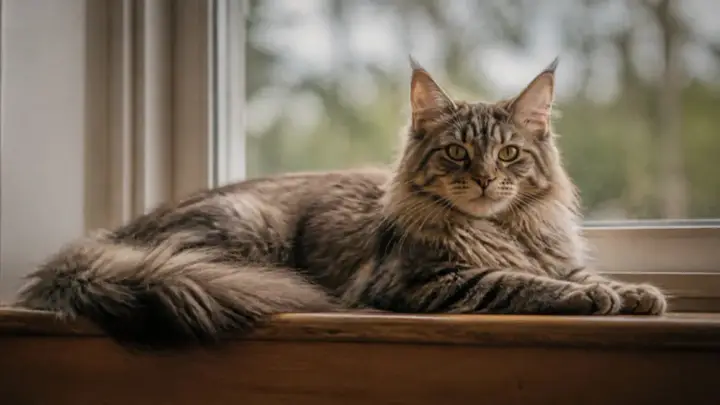
| Origin | New England, USA; history documented back to the 1850s |
|---|---|
| Size | The largest of the pedigree cat breeds; can take up to three years to reach full size |
| Weight | Mature males often around 9 kg (20 lb) or more; females are usually smaller |
| Coat | Thick and shaggy, shorter on the shoulders and longer on the sides, belly and back legs, with a long plumed tail |
| Temperament | Friendly, sociable and easy-going; usually get along well with children and other animals |
| Grooming | Comb two or three times a week for about five to ten minutes; regular baths are not needed |
| Feeding | A complete and balanced food; treats no more than 10 to 15 percent of daily calories; keep the cat lean for its hips |
| Needs | Space for a large litter box, a sturdy scratching post and cat trees, plus daily play and company |
| Common health problems | Hypertrophic cardiomyopathy (HCM), hip dysplasia and spinal muscular atrophy (SMA) |
| Screening | Ask breeders for DNA test results for HCM and SMA, hip X-ray results and any heart scans |
| See a vet at once if | Fast, difficult or open-mouthed breathing at rest, sudden pain, weakness or paralysis in the back legs, collapse or fainting |
The Maine Coon is one of the best-known cat breeds in the world. It is a large, long-haired cat with big paws, often tufted ears and a long, bushy tail. Owners often call it a gentle giant. Behind the size there are real care needs, and a few inherited health problems that are worth understanding before you bring one home. This guide also helps you decide whether the breed suits your home.
Where the breed comes from
The Maine Coon is an American breed with roots in New England. According to the Cat Fanciers' Association (CFA), its history is documented back to the 1850s, and it is thought to descend from short-haired cats that arrived on ships with early settlers. A brown tabby Maine Coon named Cosey was chosen as Best Cat at an early American cat show in 1895. It gained championship status with the CFA in 1976 and has long been one of the most popular pedigree breeds.
Size and growth
The CFA describes the Maine Coon as the largest of the pedigree cat breeds. It is also slow to mature and can take up to three years to reach its full size. Males are usually clearly bigger than females. The CFA notes that it is not unusual for a mature male to weigh around 9 kg (20 lb) or more, while females are usually smaller. Many healthy Maine Coons weigh a good deal less than that.
Because growth is slow, a young Maine Coon can look long-legged and lean for a long time. That is normal. Bigger is not better for the cat's health. A study of 5,038 pedigree Maine Coons, screened by X-ray over 20 years, found that hip dysplasia became more severe as body mass increased. The authors concluded that breeding for a very large body also tends to select for hip problems.
Personality
Maine Coons are generally described as friendly, sociable and easy-going. The CFA calls them loyal and intelligent, and says they usually get along well with children and other animals. They are fairly independent, yet many want attention when their people are at home. Rather than choosing one favorite person, many spend time with every member of the family. Some are fond of water, and the breed is not known for being especially talkative.
Every cat is an individual, though. Early socialization, past experiences and health shape personality as much as breed does. If a relaxed cat becomes grumpy, withdrawn or less active, pain is a common reason, and a vet check is worthwhile.
Coat care
The coat is thick and shaggy. It is shorter on the shoulders and longer on the sides, belly and back legs, and it ends in a long, plumed tail.
- Comb your cat two or three times a week, for about five to ten minutes each time. This reduces shedding, hairballs and mats.
- Pay extra attention to the belly, armpits, behind the ears and the long fur on the back legs.
- Check the fur under the tail, where long hair can trap stool.
- Do not try to cut a tight mat out with scissors close to the skin. Cat skin is thin and cuts easily, so ask your vet or a groomer for help.
Most Maine Coons do not need regular baths, although an occasional bath is fine. Nails, teeth and ears need the same routine care as in any other cat. Our guide to grooming dogs and cats at home covers brushing, bathing and nail trims step by step.
Feeding
Cats are obligate carnivores, which means they need nutrients found only in animal products. A commercial food labelled complete and balanced is the simplest choice. Check the label to see which life stage the food is made for. Maine Coons grow for longer than most cats, so ask your vet when your kitten should move on to an adult food.
Portions should follow your cat's body shape, not its breed. Ask your vet what a healthy weight is for your cat. Keep treats to no more than 10 to 15 percent of daily calories. Obesity is the most common nutrition-related problem in cats, and it raises the risk of arthritis and diabetes. For a breed prone to hip problems, a lean body is one of the most useful things you can give it.
Fresh, clean water should be available at all times. Raw meat can carry parasites such as Toxoplasma, and many cats do not digest milk well, so both are best avoided. For portion sizes and feeding schedules, see How to Feed Your Cat.
Heart disease (HCM)
Hypertrophic cardiomyopathy, or HCM, is a common heart disease in cats. The muscular walls of the heart become thick, so the heart pumps less efficiently. The Cornell Feline Health Center lists the Maine Coon among the breeds in which HCM is more common.
Many cats with HCM show no signs at all for a long time. When signs appear, they can include fast or difficult breathing, breathing with the mouth open and tiredness. These are caused by fluid building up in the lungs. Some cats develop a blood clot that blocks blood flow to the back legs. This causes sudden pain and weakness or paralysis of the hind legs, and it is an emergency. It is described in Saddle Thrombus in Cats.
In Maine Coons, a change in a gene called MYBPC3, known as the A31P mutation, is linked with HCM. A DNA test can show whether a cat carries no copies, one copy or two copies of it. Cats with two copies appear to be at higher risk than cats with one, but the link is not perfect. A normal result does not rule out HCM either, because other genetic causes are thought to exist. The main test for the disease itself is an ultrasound scan of the heart, called an echocardiogram. For signs, diagnosis and care, see Hypertrophic Cardiomyopathy in Cats.
Hip dysplasia
Hip dysplasia means the hip joint forms abnormally and is too loose. Over time, this leads to wear and arthritis. The condition is better known in dogs, but it is common in Maine Coons. In the study of 5,038 screened Maine Coons, 37 percent had some degree of hip dysplasia on X-rays. Males and females were affected equally, and severity increased with age and body mass.
Cats hide joint pain well, and many affected cats never limp. Instead, you may notice that your cat jumps less, moves more carefully, avoids stairs or hesitates to squat in the litter box. Your vet can examine the hips and take X-rays. Treatment usually focuses on weight control, gentle activity and pain relief prescribed by the vet. Surgery is reserved for a small number of cats. Never give human pain medicines, because many are dangerous to cats.
Breeders can screen their breeding cats with hip X-rays. In the large study, breeding away from hip dysplasia reduced its severity in later generations.
Spinal muscular atrophy (SMA)
Spinal muscular atrophy is an inherited disease of the nerve cells in the spinal cord that control the muscles. In Maine Coons, it is linked to a deletion that affects a gene called LIX1. It is recessive, so a kitten is affected only if it inherits the faulty gene from both parents. The parents themselves are healthy carriers.
Signs appear at around three to four months of age. Kittens develop weak back legs, a fine tremor and a swaying walk, and they struggle to jump. Affected kittens are not in pain. After a quicker loss of strength early on, the disease tends to slow down or level off, and many affected cats live comfortably as indoor cats for years. A DNA test identifies both affected cats and carriers, so breeders can avoid producing affected kittens.
Buying, adopting and health screening
If you buy a pedigree kitten, ask the breeder for the DNA test results for HCM and SMA, the parents' hip X-ray results and any heart scans. A responsible breeder will be glad to show them, and will expect your kitten to see your own vet soon after it arrives. Our guide to caring for a new kitten covers the first weeks at home.
Many large, fluffy cats in shelters and rescues look like Maine Coons. Some may be, and many are mixes with no known background. Looks alone cannot tell you a cat's breed. What really counts is the cat's health and temperament.
Is a Maine Coon right for you?
- Space for a big cat, including a large litter box, a sturdy scratching post that will not tip over and strong cat trees
- Time for combing several times a week
- Daily play and company, since the breed is sociable and active
- A budget for good food and vet care, including heart or hip checks if your vet recommends them
When to see a vet
Contact your vet straight away, or an emergency clinic out of hours, if your cat shows any of these signs.
- Fast, difficult or open-mouthed breathing while resting
- Sudden pain, weakness or paralysis in the back legs
- Collapse or fainting
Book a regular appointment if you notice your cat jumping less, stiffness or reluctance to use stairs, or weakness and a swaying walk in a young kitten. Weight loss, a poor appetite, a change in behavior and mats close to the skin are also worth a visit. A yearly checkup lets your vet listen to the heart, check the joints and weigh your cat. Our guide on taking your cat to the vet helps make those visits calmer.
Whatever their pedigree, many cats in shelters and rescues are waiting for homes, including big, long-haired cats that look a lot like Maine Coons. Meeting the cat tells you more than its breed ever can.
For more guides on cat care and health, browse PawPedia. Questions about adopting from us are answered in our FAQ.
See also
From our rescues

Sources
Online sources
- Maine Coon Cat · The Cat Fanciers' Association
- Hypertrophic Cardiomyopathy · Cornell Feline Health Center, Cornell University
- Maine Coon Hypertrophic Cardiomyopathy (MC-HCM) · Langford Vets, University of Bristol
- Demography, heritability and genetic correlation of feline hip dysplasia and response to selection in a health screening programme · Low M. et al., Scientific Reports (2019)
- Hip Dysplasia in Cats · PetMD
- Feline Hip Dysplasia · PawPeds
- An approximately 140-kb deletion associated with feline spinal muscular atrophy implies an essential LIX1 function for motor neuron survival · Fyfe J.C. et al., Genome Research (2006)
- Spinal Muscular Atrophy in Maine Coon Cats (SMA) · PawPeds
- Feeding Your Cat · Cornell Feline Health Center, Cornell University
Encyclopedias
- Maine Coon · Wikipedia
- Maine coon cat · Encyclopædia Britannica
- С. П. Красносельская. Мэйн-кун [Maine coon] · Большая российская энциклопедия, электронная версия (archived copy)
- Cat · Encyclopædia Britannica
- ネコ [Cat] · 日本大百科全書(ニッポニカ), 小学館, via Kotobank
- О. А. Сизова. Кошка домашняя [Domestic cat] · Большая российская энциклопедия, электронная версия (archived copy)
Books
- Fogle B. The New Encyclopedia of the Cat. New York: DK Publishing, 2001. ISBN 9780789480217
- Morris D. Cat Breeds of the World: A Complete Illustrated Encyclopedia. New York: Viking, 1999. ISBN 9780670886395
- Gough A, Thomas A, O'Neill D. Breed Predispositions to Disease in Dogs and Cats. 3rd ed. Hoboken, NJ: Wiley-Blackwell, 2018. ISBN 9781119225546
- Блохина Т. В. Фелинология: учебное пособие [Felinology: A Study Guide]. 2-е изд. Санкт-Петербург: Лань, 2014. ISBN 9785811415175
- 大石孝雄. ネコの動物学 [The Zoology of the Cat]. 東京: 東京大学出版会, 2013. ISBN 9784130622240
This article is general information, not veterinary advice. Always consult a veterinarian about your animal’s health. Some pictures in PawPedia may be AI-generated.
This page was last updated on October 27, 2026.